Buying Water, Drinks and Pfand Explained Simply
For many people, buying a water bottle is the first real interaction with daily life in Germany. It looks simple, but the types of water, bottles, prices, and machines can be confusing on day one.
This guide explains everything you need to know, step by step.
What Types of Water Are Available in Germany?
Germany has a strong drinking water culture. You’ll find two main types of water available:
Still Water (Stilles Wasser)
Still water has no carbonation. It’s called:
- Still or Ohne Kohlensäure (without carbonation)
- Tastes like plain drinking water
- Popular with older Germans and people who prefer calm beverages
- Usually slightly cheaper than sparkling
Sparkling Water (Sprudelwasser)
Sparkling water is carbonated. It’s called:
- Sprudel or Mit Kohlensäure (with carbonation)
- Fizzy and refreshing
- Extremely popular in Germany (Germans drink more sparkling water than still)
- Feels like carbonated mineral water or club soda
- Same price or slightly more than still water
The surprising part: Germans have strong opinions about which they drink. Sparkling water is actually more common than still water in German households.How to Identify the Difference When You Buy Water
How to Identify the Difference When You Buy Water
When you’re in the supermarket, it’s easy to confuse still and sparkling water because the bottles look similar.
How to tell the difference:
Look at the label:
- Still water: Label shows “Still” or “Ohne Kohlensäure” (no carbonation)
- Sparkling water: Label shows “Sprudel” or “Mit Kohlensäure” (with carbonation)
Look at the bottle shape:
- Still water: Usually has a blue or green label
- Sparkling water: Usually has a colored label (red, orange, green) — the color varies by brand
Ask yourself:
- Uncertain? Just pick one. You’re not making a permanent decision. You can try still next time if you don’t like sparkling.
Pro tip: Many supermarkets organize water by type. Ask a staff member: “Wo ist das Stille Wasser?” (Where is the still water?) or “Wo ist der Sprudel?” (Where is the sparkling water?). Employees are used to helping confused customers.What Other Drinks Are Available in Supermarkets?
What Other Drinks Are Available in Supermarkets?
Beyond water, German supermarkets stock many beverages:
Non-alcoholic drinks:
- Juice (Saft): Apple, orange, mixed fruit. Often concentrated or freshly squeezed
- Lemonade (Limonade): Sugary sodas (Fanta, Sprite, etc.)
- Schorle: Half juice, half sparkling water (very popular, healthier option)
- Iced tea (Eistee): Pre-made or powder to mix
- Coffee and tea: Ready-to-drink bottles
- Milk (Milch): Regular, lactose-free, plant-based alternatives (Hafer, Soja, Mandel = oat, soy, almond)
- Smoothies: Fresh or bottled
- Sports drinks: Electrolyte drinks (less common than in US)
Alcoholic drinks:
- Beer (Bier): German specialty, huge selection
- Wine (Wein): From Germany and worldwide
- Spirits (Schnaps): Schnapps, vodka, whiskey
- Cider (Apfelwein): Apple cider, popular in the Frankfurt region
What’s important for newcomers: Most drinks are sold in bottles (plastic or glass). The pricing system is the same for all of them, and all glass/plastic bottles usually have Pfand (deposit).
Buying Bottles: Single or Cases (Kasten)?
Germans buy drinks in two ways:
Single bottles:
- What it is: Buy one, two, or a few bottles at a time
- Where: Pick from shelf, grab as many as you want
- Price: Higher per bottle (€0.80-1.50 per liter)
- Best for: First-time buyers, trying new drinks, short-term visitors
- No commitment: Buy what you need today
Cases (Kasten or Kiste):
- What it is: 6, 12, or 24 bottles sold together as one unit
- Where: Usually on lower shelves, heavier to carry
- Price: Much cheaper per bottle (€0.40-0.70 per liter)
- How it works: You buy the whole case, use bottles, return empties, and get Pfand back
- Best for: People staying long-term, regular drinkers, budget-conscious shoppers
- Delivery option: Some supermarkets deliver cases to your home (ask at checkout)
Which should you choose?
Day 1 advice: Buy single bottles. You’re exploring and don’t need 12 bottles yet.
After 1 week: If you like a drink, buy it in a case. You’ll save 30-40% on cost.
Important: Cases are heavy. If you don’t have a car, ask if delivery is available. Carrying 12 bottles home is exhausting.
What is Pfand? (The Deposit System Explained)
This is the part that surprises most new arrivals to Germany.
The simple explanation:
Pfand = A refundable deposit on bottles
How it works:
- When you buy a bottle, you’re paying two things:
- The drink (€1.20)
- The deposit for the bottle (€0.25)
- When you return the empty bottle, you get the deposit back
- It’s not a tax. It’s your money, returned when you bring the bottle back.
Why does Germany have this system?
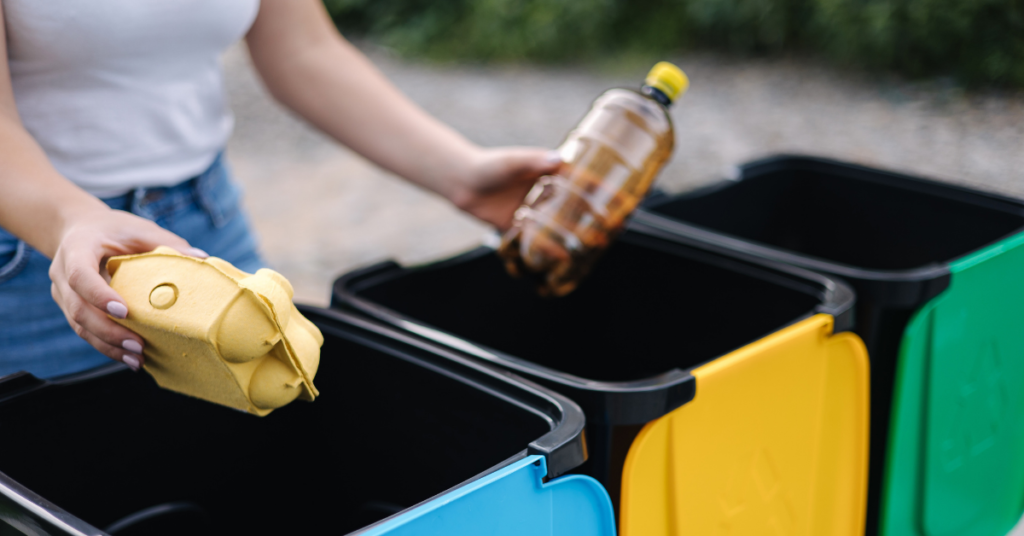
Germany takes recycling seriously. The deposit system encourages people to:
- Return bottles instead of throwing them away
- Recycle responsibly
- Reduce waste in landfills
- Support a circular economy
The result: Germans have one of the best recycling rates in the world, and bottle collectors have a way to earn money.
What you need to know:
- It’s normal: Every German expects this system
- It’s not optional: If a bottle has Pfand, you pay it
- You get it back: As long as you return the bottle
- No time limit: Return bottles anytime — no deadline
You can read more about Pfand Here.
How to Recognise the Pfand Symbol on Bottles
Not all bottles have Pfand, and you need to know which ones do before you buy.
Look for the Pfand symbol:
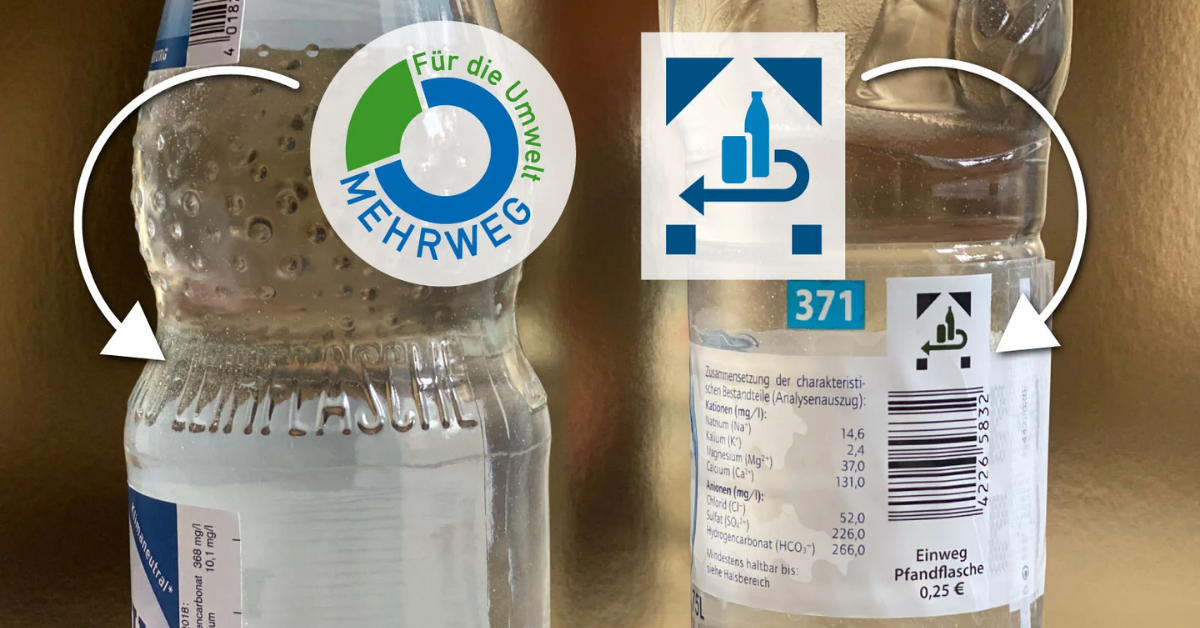
The bottle will have a logo showing a bottle, a can and an arrow or text that says “Pfand”.
Where to find it:
- On the front label (usually bottom corner)
- On the back label (usually near barcode)
- On the shelf tag next to the price
Which bottles typically have Pfand:
WITH Pfand:
- Most plastic water bottles ✅
- Most glass water bottles ✅
- Glass beer bottles ✅
- Plastic soda bottles ✅
- Glass juice bottles ✅
- Wine bottles (sometimes) ✅
WITHOUT Pfand:
- Milk cartons ❌
- Juice cartons (Tetrapak) ❌
- Plastic juice bottles (some brands) ❌
- Plastic dairy bottles ❌
If you’re unsure:
- Ask the staff: “Hat das Pfand?” (Does this have a deposit?)
- Look at the shelf tag, and it usually shows the deposit amount.
- Don’t worry if you get it wrong, it’s not a big deal.
Pro tip: On your first visit, just buy one or two bottles and see what happens at checkout. The system will make sense immediately.
Price with Pfand: What You’ll Pay at Checkout
Here’s where the confusion happens for first-timers.
What you’ll see at the shelf:
The price tag shows €1.20 for a 1.5L water bottle.
You think: “Okay, €1.20. I’ll buy it.”
What happens at checkout:
The cashier rings it up. Your total is €1.45 instead of €1.20.
You think: “Wait, did I get overcharged?”
Answer: No. This is normal.
Here’s the breakdown:
| ITEM | PRICE |
|---|---|
| 1.5L Water | €1.20 |
| Pfand (deposit) | +€0.25 |
| Your total at checkout | €1.45 |
When you return the bottle:
You’ll get €0.25 back when you return the empty bottle to the machine.
Real-life example:
- Monday: You buy water for €1.45 (including €0.25 Pfand)
- Wednesday: You finish the bottle and return it
- At return: You get €0.25 back
- Your actual cost: €1.20 (the Pfand was just a deposit)
Common Pfand amounts:
- 0.08 € – Small plastic bottles
- 0.15 € – Medium plastic bottles, some glass
- 0.25 € – Large bottles, cases of water, beer bottles
The confusion moment:
Everyone feels confused at first checkout. This is completely normal. After you see it once, it makes perfect sense.
Returning Bottles and Getting Your Money Back
Once you’ve finished your drink, you have an empty bottle with value. Here’s exactly how to get your money back.
Step 1: Find the machine
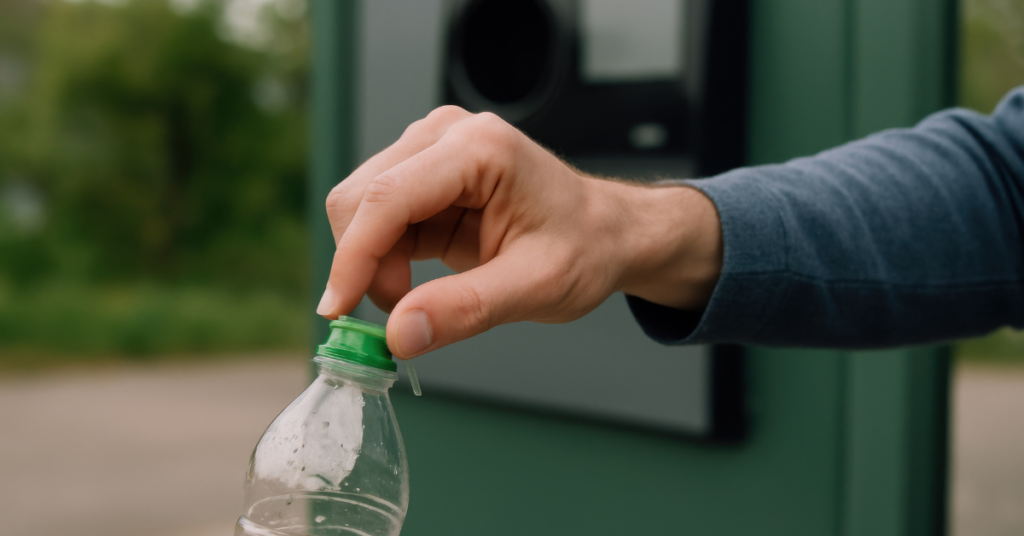
Bottle return machines (called Pfandautomaten) are at almost every supermarket. Look for large vending-machine-style machines:
- The size of a large refrigerator
- Located near the entrance or exit
- Sometimes inside near checkout
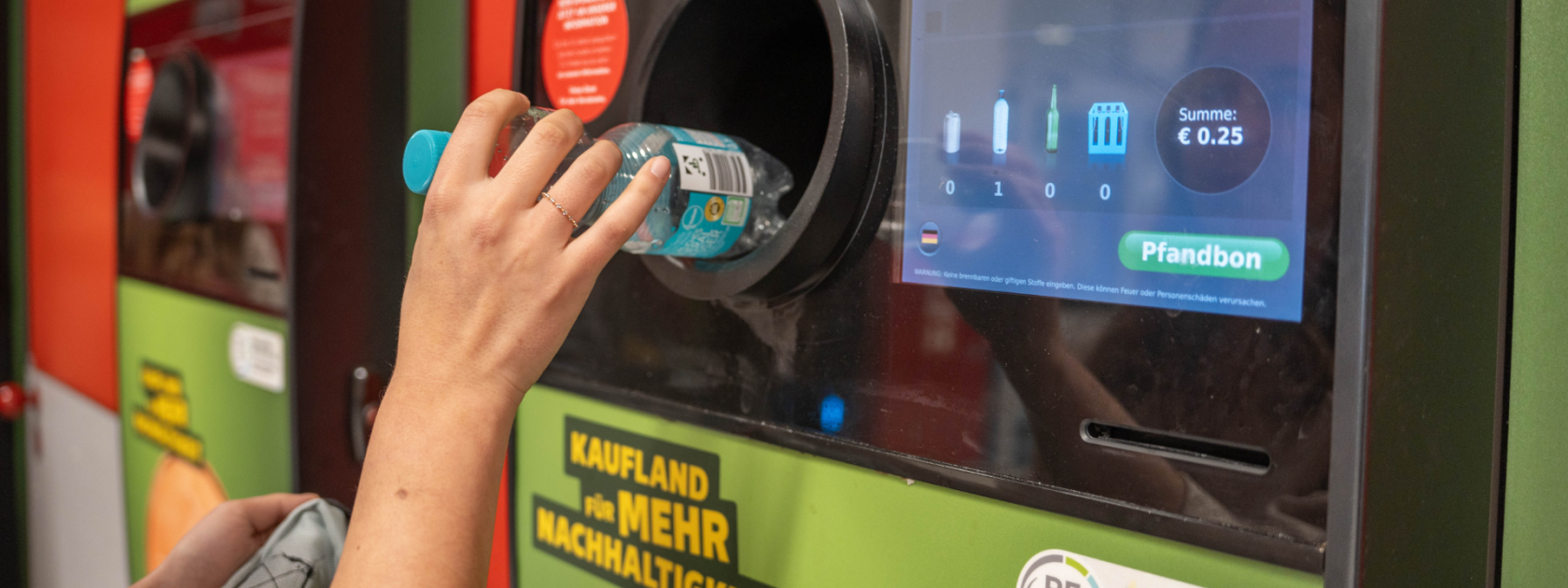
Can’t find it? Ask staff: “Wo ist der Pfandautomat?” (Where is the return machine?)
Step 2: Insert your bottles
- Pick up your empty bottle
- Insert it into the machine opening
- The machine scans the barcode
- Listen for the beep (means it accepted it)
- Repeat with each empty bottle
Step 3: Get your receipt
- After inserting all bottles, press the button (usually says “Beleg / Pfandbon / Bon” or has a receipt symbol)
- A paper receipt prints out
- This receipt shows how much Pfand you earned
Step 4: Get your money back
- Take the receipt to the checkout counter
- Give it to the cashier
- They’ll either:
- Give you cash (if you ask)
- Subtract it from your next purchase (faster)
That’s it. No interaction with staff needed unless you want cash instead of a discount.
What if the machine doesn’t accept your bottle?
Sometimes machines reject bottles because:
- It’s not a deposit bottle (no Pfand)
- The barcode is damaged
- It’s from a different region/brand they don’t accept
Solution: Take it to the checkout and show staff. They’ll handle it.
How much will you get back?
- One 1.5L bottle with 0.25 € Pfand = 0.25 € back
- Six bottles with 0.25 € each = 1.50 € back
- A case of 12 waters = 3.00 € back (if 0.25 € each)
Many Germans save up bottles and return them monthly, getting €10-20 back. It adds up.
Bottles in the Trash: Why You Shouldn’t (But It’s Not a Disaster)
You technically can throw bottles in the trash. But here’s why Germans don’t.
Why you shouldn’t throw away deposit bottles:
You lose money:
- Every bottle = lost deposit
- 12 bottles = €3 lost (not huge, but wasteful)
- Over a year, that’s €30-50 wasted
Environmental impact:
- Throwing away recyclable bottles defeats the purpose
- Germany’s recycling system depends on returns
- It’s environmentally irresponsible (Germans take this seriously)
Social expectations:
- Germans notice. Throwing valuable bottles away seems wasteful.
- Your landlord or neighbors might comment
- It’s seen as disrespectful to the recycling system
Income for others:
- Bottle collectors (called Pfandsammler) collect discarded bottles to earn money
- Returning bottles properly respects this system
- Many people depend on bottle returns for income
What actually happens if you throw bottles away?
Honestly? Nothing terrible. You won’t get fined. You won’t get in trouble.
But:
- You’re wasting money
- You’re not recycling
- You’re creating unnecessary trash
- Germans will judge you (silently)
The right approach:
- Return your bottles to the machine
- It takes 2 minutes
- You get your money back
- Everyone’s happy
If you absolutely forget once or twice?
It’s fine. Don’t stress. Just start returning them going forward.
Quick Summary: Everything You Need to Know
- Still water (Stilles Wasser) = no bubbles. Sparkling water (Sprudel) = bubbly. Sparkling is more popular in Germany.
- Single bottles are fine for first-timers. Cases are cheaper if you stay long-term.
- Pfand = a refundable deposit. You pay it with the bottle, get it back when you return it.
- Look for “Pfand” symbol or amount on the label. Most water/soda bottles have it.
- At checkout, your total will be higher than shelf price. That’s the Pfand. It’s normal.
- Bottle return machines (Pfandautomaten) are at most supermarkets. Just insert bottles, get receipt, cash in at checkout.
- Returning bottles takes 2 minutes and gets you money back. Always return them instead of throwing away.